![PSII white-01-3.png]](https://kb.psii.global/hs-fs/hubfs/PSII%20white-01-3.png?height=40&name=PSII%20white-01-3.png)
Scope:
Once an employer files T4 slips and a summary for the year, the CRA will check for deficiencies in CPP contributions and EI premiums. If CRA has discovered errors, a Pensionable and Insurable Earnings Review (PIER) notice will be issued. The employer is responsible for reviewing and verifying the information provided in the PIER notice and responding to CRA accordingly.
Understanding the PIER Notice:
If there are discrepancies between the required and reported amounts, the results are printed on a PIER notice.
SAMPLE PIER
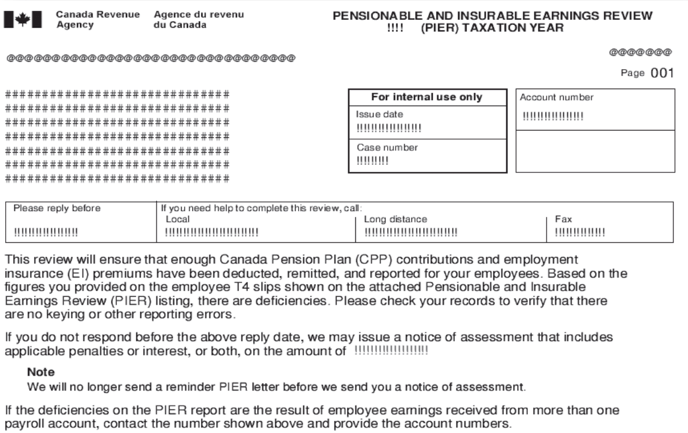
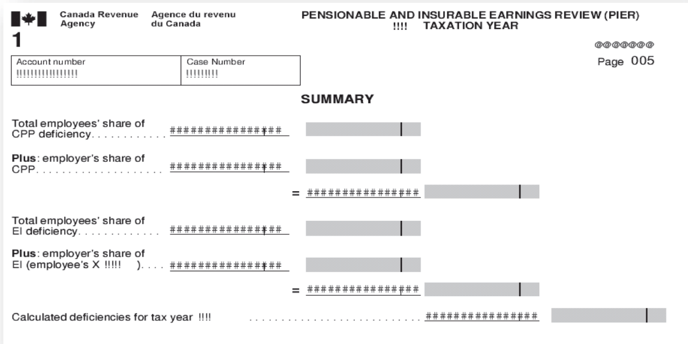
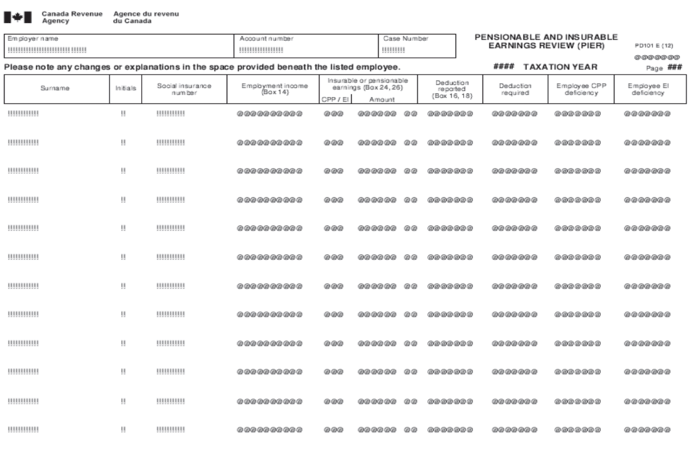
The PIER will outline the following information for each entry:
- employee's name and social insurance number (SIN)
- employee reference number (if included on electronic media return)
- taxable income reported in Box 14
- pensionable earnings reported in Box 26
- insurable earnings reported in Box 24
- Canada Pension Plan contributions reported in Box 16
- Employment Insurance premiums reported in Box 18
- deficiencies in either the CPP contributions or EI premiums
Understanding CPP Contributions and the Calculation:
The CRA identifies CPP deficiencies by subjecting every T4 slip to the following calculation:
|
Pensionable earnings as reported on the T4 slip Box 26 |
- |
CPP basic annual exemption |
x |
Applicable CPP rate for the year |
= |
CPP contributions required |
If an employee did not work for the employer for the complete year, the CPP exemption would be the result of the pay period exemption multiplied by the number of pays with pensionable earnings.
When the result of the above calculation is greater than the amount reported in Box 16, it will result in an entry on the PIER report.
|
Quick Tip |
If an "X" appears in Box 28 with amounts reported in either Box 16 or Box 26 the "X" will be ignored, and this test will be performed.
Example:
An employee has worked 22 bi-weekly pay periods and has $37,950 in pensionable income:
( $37,950.00 - ( 134.61 x 22 ) ) x 5.95% = $2,081.82
|
2023 CPP Contribution Limits |
|
|
Annual maximum pensionable earnings |
$66,600.00 |
|
Annual basic exemption |
$3,500.00 |
|
Annual contributory earnings |
$63,100.00 |
|
Annual contribution rate |
5.95% |
|
Annual maximum contribution (applies to both employee and employer) |
$3,754.45 |
PRO-RATE MAXIMUM CPP CONTRIBUTION:
The maximum CPP contribution may be pro-rated in a year in which the employee:
-
- turns 18 (contributions begin the first pay in the month following the 18th birthday)
- turns 70 (contributions end the last pay in the month of the 70th birthday)
- is considered disabled under CPP or QPP
- is between 65 ‒ 70, is collecting CPP or QPP pension and has filed a CPT30 form
- becomes deceased
The following formula is used to pro-rate the CPP contribution:
- Annual maximum CPP contribution
- Divide by 12
- Multiply the result of Step 2 by the number of months the employee is in pensionable employment
Example:
Carmelita turns 70 in February 2023 and earns an annual income of $72,000.
The pro-rated CPP maximum for 2023 will be:
( 3,754.45 ÷ 12 ) x 2 = $ 625.74 Pensionable earnings will be: ( $66,600.00 x 2 ) ÷ 12 = $11,100.00
PAY PERIOD C/QPP EXEMPTIONS:
|
Employee's C/QPP Basic Exemption for Various Pay Period Frequencies: |
|
|
Pay period |
Basic exemption |
|
Annually (1) |
$3,500.00 |
|
Semi-annually (2) |
$1,750.00 |
|
Quarterly (4) |
$875.00 |
|
Monthly (12) |
$291.66 |
|
Semi-monthly (24) |
$145.83 |
|
Bi-weekly (26) |
$134.61 |
|
Bi-weekly (27) |
$129.62 |
|
Weekly (52) |
$67.30 |
|
Weekly (53) |
$66.03 |
|
22 pay periods |
$159.09 |
|
13 pay periods |
$269.23 |
|
10 pay periods |
$350.00 |
|
Daily (240) |
$14.58 |
|
Hourly (2,000) |
$1.75 |
CPP EXEMPTION DOES NOT APPLY:
No CPP exemption is applied to irregular payments, such as bonuses or retroactive pay increases when paid separately from regular pay period remuneration.
The following calculation can be found in T4001 Employers’ Guide - Payroll Deductions and Remittances, available on the Government of Canada website. More information on CPP contribution overpayment refunds to follow.
Understanding EI Premiums and the Calculation:
The CRA subjects every T4 Slip to the following calculation to verify EI premiums:
|
Insurable earnings as reported on the T4 slip Box 24 |
x |
EI premium rate for the year |
= |
EI premiums |
When the result of the above calculation is greater than the amount reported in Box 18, it will result in an entry on the PIER report.
|
Quick Tip |
If an "X" appears in Box 28 with amounts also reported in either Box 18 or Box 24 the "X" will be ignored, and this test will be performed.
Example:
An employee has earned $37,950 in insurable income:
$37,950.00 x 1.63% = $ 618.59
|
2023 EI Premium Limits |
Outside Quebec |
|
Annual maximum insurable earnings |
$61,500.00 |
|
Annual premium rate |
1.63% |
|
Annual maximum employee EI premium |
$1,002.45 |
|
2023 EI Premium Limits |
Within Quebec |
|
Annual maximum insurable earnings |
$61,500.00 |
|
Annual premium rate |
1.27% |
|
Annual maximum employee EI premium |
$ 781.05 |
Common Causes of CPP and EI Deficiencies:
The CRA has implemented upfront detection functionality on the T4 WebForms application. Employers who file their T4 slips online using this application will be presented with an error message if a CPP contribution or EI premium deficiency is detected on a T4 slip. The employer can either ignore the message or correct the slip.
Employers who choose to ignore the message will receive a PIER report once the processing of the summary has been completed. Responding to the error message and making necessary changes to the T4 slip will reduce late penalties.
|
Quick Tip |
A PIER for CPP or EI deficiencies might be generated by CRA, but no actual CPP contributions or EI premiums are necessary if there is an explanation. This is referred to as a false deficiency.
|
Common Causes of CPP and EI Deficiencies |
||
|
Reason |
CPP Deficiency |
EI Deficiency |
|
Incorrect earnings reported |
Box 26 Pensionable earnings Include all pensionable earnings up to the annual maximum for all employees between 18-70 years of age. Exceptions: · employee is considered disabled under CPP or QPP · employee is between 65-70 years of age, collecting a CPP or QPP pension, and has filed form CPT30 |
Box 24 Insurable earnings Include all insurable earnings up to the annual maximum for all employees. No age exemption for EI.
Top-up maternity, parental or compassionate care leave benefits are not insurable and not reported in Box 24. |
|
|
|
|
|
Taxable benefit reporting |
Taxable benefits are pensionable earnings and should be included in an employee’s income when they are received or as they are enjoyed. Adding taxable benefits to the T4 slip at year-end may lead to a PIER. |
Cash taxable benefits, such as employer contributions to an unrestricted RRSP, are insurable. |
|
|
|
|
|
CPP exemption |
Only one CPP exemption is applied in a pay period. If a second payment is issued, such as a bonus or pay adjustment, do not allocate the CPP exemption again. |
|
|
|
|
|
|
Transfer to an RRSP account |
Employees may request a transfer of earnings, such as a bonus, to their RRSP account. Only income tax is exempt. If the earnings are pensionable, CPP contributions must be withheld and remitted. |
Employees may request a transfer of earnings, such as a bonus, to their RRSP account. Only income tax is exempt. If the earnings are insurable, EI premiums must be withheld and remitted. |
Recovering CPP Contribution and EI Premium Shortages:
If the calculations determined from the audit check show a shortage of CPP contributions or EI premiums, the following procedures apply:
STEP 1:
CPP shortage:
Include the employee portion of the shortage amounts in Box 16 on the T4 slip. Add both the employer (matches the employee contribution) and the employee portion of the CPP contributions shortage to the other source deduction amounts for the last remittance for the year. If paid after the last remittance, ensure the payment is allocated to the correct tax year.
EI shortage:
Include the employee portion of the shortage amounts in Box 18 on the T4 slip. Add both the employer (1.4 times the employee premiums unless a reduced rate applies) and the employee portion of the EI premium shortage to the other source deduction amounts for the last remittance for the year. If paid after the last remittance, ensure the payment is allocated to the correct tax year.
STEP 2:
Employers may recover any CPP contribution and EI premium shortages from the employee provided that:
- CPP contributions or EI premiums withheld from subsequent pays are within 12 months of the date the amount should have been deducted
- the amount recovered each subsequent pay period is not greater than the deduction amount that would have been deducted in one pay period
- the current CPP contribution or EI premium code is not used; rather, create a new deduction code, i.e., MISC. CPP/EI or CPP/EI prior year
Example:
When finalizing T4 slips in January, it was determined that a CPP contribution error was made on payments to a new employee hired on November 16th. Due to an incorrect date of birth in the payroll system, no CPP contributions were withheld on the three semi-monthly pays issued to the employee in the prior year.
1. The employer immediately determines the amount of CPP contributions that should have been withheld and remits the employee and employer portion. The employee’s T4 slip is amended to include the employee's CPP contributions in Box 16.
2. The employer may recover the employee contributions from future pay(s) if:
-
-
-
- the error was detected within 12 months of the payment date the error occurred.
-
-
-
-
-
- the CPP contribution that should have been withheld in each semi-monthly pay was $135.92. The employer is permitted to deduct this amount over three pay periods to recover the amount paid on the employee’s behalf (unless the employee agrees to a higher deduction over fewer pay periods).
- create a deduction code for prior year CPP recovery.
-
-
If a PIER report is received from the CRA (after the T4 slips have been filed), filing amended slips is not required. Respond to the PIER advising of the changes required for the employees on the report, along with payment of the employee and employer portions if necessary.
|
Quick Tip |
Do not transfer any amount of the shortage from the income tax withheld.
CPP Contribution and EI Premium Over Deductions:
If, during the year, the employee was over deducted CPP contributions or EI premiums, the employee should be reimbursed for the overpayment before the final pay period of the year.
If a refund of an overpayment for CPP contributions or EI premiums deducted from an employee cannot be processed, show the total CPP contributions and EI premiums deducted and the correct pensionable and insurable earnings on the T4 slip. The employee will receive any refund owed when they file their T1 income tax return.
The employer may recover their share of an overpayment by completing form PD24— Application for a Refund of Over deducted CPP Contributions or EI Premiums, a procedure often ignored by employers due to the administrative burden of preparing the form.
What is the timeline for a PIER process:
|
Timeline |
Steps in the PIER process |
|
Day 1 |
Initial letter (PIER package) sent to you which requests a reply within 30 calendar days |
|
Day 45 |
If you do not reply or make a payment in full, a notice of assessment is issued |
|
Day 65 |
The CRA will issue amended T4s to you |
How to respond to a PIER:
You are not required to respond to the PIER if you agree with the CRA's calculations and you will be remitting payment for the exact amount shown on the PIER by the deadline.
You are required to respond to the PIER if you do not agree with the CRA's calculations. You must respond by returning the PIER with any corrected information and an explanation. The response can be sent using one of the following:

What If you do not respond to the PIER?
If you do not reply or make a payment in full by the reply date noted on the PIER, a notice of assessment will be issued to you. The notice of assessment will include applicable penalties or interest, or both.
In either situation, do not send amended T4 slips. The CRA will issue any amended slip to you.
What are the payment methods:
If you are using MyBusinessAccount, you will have a Proceed to pay option in the PIER Overview section. This will allow you to do one of the following:

This payment option is not available in RAC.
What if you have multiple payroll accounts:
If you have multiple payroll program account extensions, the CRA will compare all T4 information returns for your business number to verify the PIER information and will contact you if there are CPP or EI deficiencies.
If the CRA does not find any deficiencies, you will not be contacted.
Contact the CRA:
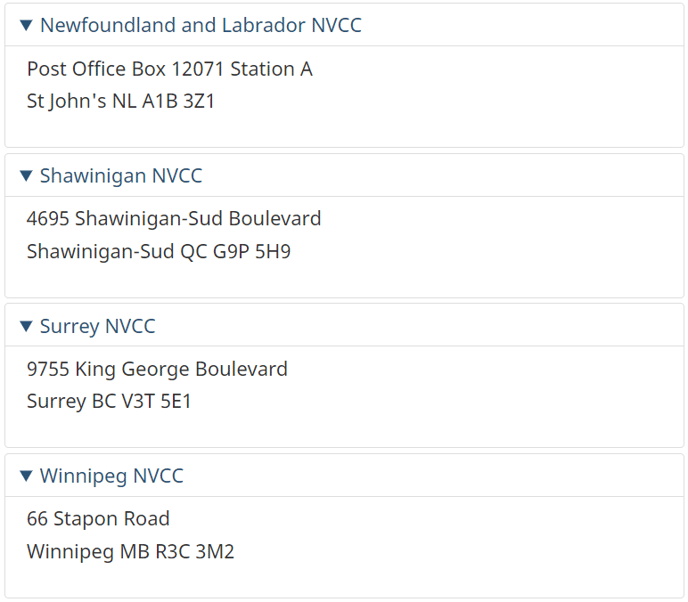
If you have any questions, contact the PIER unit at your National Verification and Collection Centres (NVCC).
Conclusion:
It's important for employers to review PIER reports carefully and address any errors promptly to ensure accurate CPP contributions and compliance with regulatory requirements. Employers can correct errors by submitting adjustments and amendments to the CRA as necessary.
Resources:
National Payroll Institute: Year-End Guide
Canada Revenue Agency: https://www.canada.ca/en/revenue-agency/services/tax/businesses/topics/payroll/file-information-returns-slip-summaries/receiving-payroll/earnings-review.html