![PSII white-01-3.png]](https://kb.psii.global/hs-fs/hubfs/PSII%20white-01-3.png?height=40&name=PSII%20white-01-3.png)
Purpose:
The Canada Revenue Agency (CRA) oversees the administration and collection of taxes in Canada. For businesses, understanding remittance schedules, thresholds, reporting requirements, and payment methods is crucial to ensure compliance with tax regulations.
Payroll Remittance Schedules and Thresholds:
Frequency of Remittance:
Employers in Canada are required to withhold and remit payroll deductions for income tax, Canada Pension Plan (CPP) contributions, and Employment Insurance (EI) premiums on behalf of their employees.
The frequency of remittance depends on the total average monthly withholding amount (AMAA) calculated for the previous calendar year. The AMRA is the total amount of deductions remitted to the CRA over the calendar year divided by the number of months in the year.
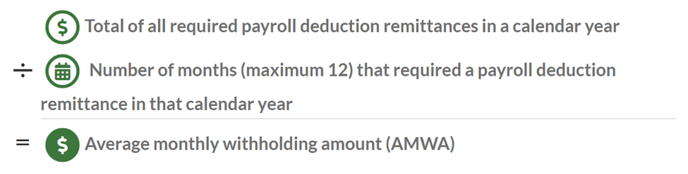
Every November, the CRA conducts a review of all payroll accounts to determine remitter types.
If your organization’s remitter type changes, CRA will issue a notice in writing via mail and/or electronically on My Business Account.
If your organization has more than one payroll account, the remitter type will be the same for all accounts. If your organization is an associated corporation, the remitter type is the same as that of all your associated corporations.
Thresholds:
The thresholds for determining remittance frequency are as follows:
|
Threshold |
Eligibility |
AMWA |
Remitting Frequency |
Remitting Period(s) |
|
Quarterly remitter
|
New small employer with a perfect compliance record
|
$0 to $999.99
|
Quarterly
|
January 1 to March 31, April 1 to June 30, July 1 to September 30, October 1 to December 31
|
|
Quarterly remitter
|
Small employer whose payroll account has been over for at least 12 months with a perfect compliance record
|
$0 to $2,999.99
|
Quarterly
|
January 1 to March 31, April 1 to June 30, July 1 to September 30, October 1 to December 31
|
|
Regular remitter
|
Employer that does not qualify as a quarterly small employer |
$0 to $24,999.99
|
Monthly
|
Calendar month (first to last day)
|
|
Accelerated remitter – Threshold 1
|
|
$25,000.00 to $99,999.99
|
Twice a month
|
1st to 15th of the month, 16th to end of the month
|
|
Accelerated remitter – Threshold 2
|
|
$100,000.00 or more
|
Four times a month
|
1st to 7th of the month, 8th to 14th of the month, 15th to 21st of the month, 22nd to the last day of the month |
Remittance Reporting:
Remittance Form:
Employers report and remit payroll deductions using Form PD7A, which is a combined statement of account for current source deductions. This form details the total deductions withheld from employees' pay, including income tax, CPP contributions, and EI premiums.
Online Reporting:
Employers can use the CRA's online services to report payroll deductions. The CRA offers various online options for remittance, including My Business Account, Represent a Client, and the CRA BizApp.
Important:
When your organization does not have any employees during a remittance period, CRA requires a NIL remittance to be reported.
Making Payments:
Payment Options:
Employers have several options for making payroll remittances to the CRA, including online payments, in-person payments at financial institutions, and pre-authorized debit (PAD) payments.
Some common payment methods include:
- Pre-authorized debit (PAD): Businesses can set up a PAD agreement with the CRA, allowing the agency to automatically withdraw the remittance amount from their bank account on the specified due date.
- Online banking: Businesses can use their online banking platform to make a payment to the CRA. They will need to add the CRA as a payee and enter the necessary information, such as their business number and remittance account number.
- In-person banking: Businesses can visit their financial institution in-person to make a payment to the CRA.
- My Payment: Businesses can use a debit cardto pay with CRA's My Payment service. Credit Cards are not an accepted method of payment with MyPayment.
- Third party: Some third-party service providers will accept a payment and send it to the CRA on your organization’s behalf.
- Cheque or money order: Businesses can also choose to mail a cheque or money order payable to the Receiver General for Canada to the appropriate CRA remittance address.
Due Dates:
The due dates for remitting payroll deductions vary depending on the remittance frequency.
|
Threshold |
Remitting Frequency |
Remitting Period(s) |
Remittance Due Date(s) |
|
Quarterly remitter
|
Quarterly
|
January 1 to March 31, April 1 to June 30, July 1 to September 30, October 1 to December 31
|
April 15, July 15, October 15, January 15
|
|
Quarterly remitter
|
Quarterly
|
January 1 to March 31, April 1 to June 30, July 1 to September 30, October 1 to December 31
|
April 15, July 15, October 15, January 15
|
|
Regular remitter
|
Monthly
|
Calendar month (first to last day)
|
15th day of the next month
|
|
Accelerated remitter – Threshold 1
|
Twice a month
|
1st to 15th of the month, 16th to end of the month
|
25th day of same month, 10th day of the next month
|
|
Accelerated remitter – Threshold 2
|
Four times a month
|
1st to 7th of the month, 8th to 14th of the month, 15th to 21st of the month, 22nd to the last day of the month
|
3rd working day after the 7th, 3rd working day after the 14th, 3rd working day after the 21st, 3rd working day after the last day of the month
|
Important:
When a due date falls on a Saturday, Sunday, or public holiday recognized by the CRA, payment is considered on time if the CRA receives it on or it is processed at a Canadian financial institution on or before the next business day.
Penalties for Late Payments:
It's important to note that businesses should always ensure that their payment is made on or before the specified due date to avoid any penalties or interest charges. Employers who fail to remit payroll deductions on time may be subject to penalties and interest charges by the CRA. Penalties are calculated based on the amount of overdue remittances and the number of days they are late.
|
PENALTIES |
|
|
When CRA will charge penalties |
Penalty rate imposed |
|
Over $500, but do not send them to the CRA
Over $500, but send them to the CRA late
Under $500, and knowingly or under circumstances of gross negligence do not send them to the CRA or send them late |
3% if the amount is 1 to 3 days late
5% if it is 4 or 5 days late
7% if it is 6 or 7 days late
10% if it is more than 7 days late, or if no amount is remitted
20% if this is the second or subsequent time you are assessed this penalty in a calendar year, if the failures were made knowingly or under circumstances of gross negligence |
|
INTEREST |
||
|
CRA may apply interest from the day the payment was due |
||
|
Sets the interest rate every calendar quarter, based on prescribed interest rates |
Compounds the interest daily
|
Applies interest to unpaid penalties
|
Conclusion:
In summary, employers in Canada must adhere to CRA's payroll remittance schedules, thresholds, reporting requirements, and payment procedures to ensure compliance with tax regulations and avoid penalties. Keeping accurate records and timely remittance of deductions are essential responsibilities for employers.
Resources:
Canada Revenue Agency: https://www.canada.ca/en/revenue-agency/services/tax/businesses/topics/payroll/remitting-source-deductions.html