![PSII white-01-3.png]](https://kb.psii.global/hs-fs/hubfs/PSII%20white-01-3.png?height=40&name=PSII%20white-01-3.png)
What is a CNESST Statement of Account/Notice of Assessment and Its Purpose?
This mandatory insurance protects employers against potentially substantial financial liabilities in cases of work-related accidents or occupational diseases and provides employees with a guaranteed income.
The CNESST sends employers the Statement of Account and Assessment Notice with regard to Québec’s Occupational Health and Safety Plan at least once a year. The Statement of Account lists all transactions relative to your insurance premium payments. The Assessment Notice indicates the insurance premium amounts that are payable, as determined by the CNESST.
Record of Transactions:
The statement of account provides a record of financial transactions between an employer and the CNESST. This may include payments made by the employer for workers' compensation, contributions to the health and safety fund, and other fees or assessments.
Account Balances:
The statement of account includes information about the current account balances. This helps employers track their financial obligations and ensures that they are meeting their payment requirements.
Payment Instructions:
The statement of account provides instructions on how and when to remit the payment balances to CNESST. It typically includes details on payment methods, due dates, and where to send the payment.
Remittance Voucher:
The statement often includes a detachable remittance voucher that employers can use when submitting their payments to the CNESST. This voucher provides essential information for correctly allocating the payment to the appropriate accounts.
Recordkeeping:
Employers are required to keep accurate records of their premiums and remittances. The statement of account serves as an important document for recordkeeping purposes, helping businesses maintain organized and compliant financial records.
Compliance Monitoring:
Employers can use the statement of account to verify their compliance with CNESST regulations. It ensures that the required payments and contributions have been made in accordance with the established standards and legal requirements.
Communication Tool:
The statement of account serves as a communication tool between the CNESST and employers. It provides a clear and detailed breakdown of financial transactions, making it easier for employers to understand their financial responsibilities and obligations.
Understanding the Statement of Account
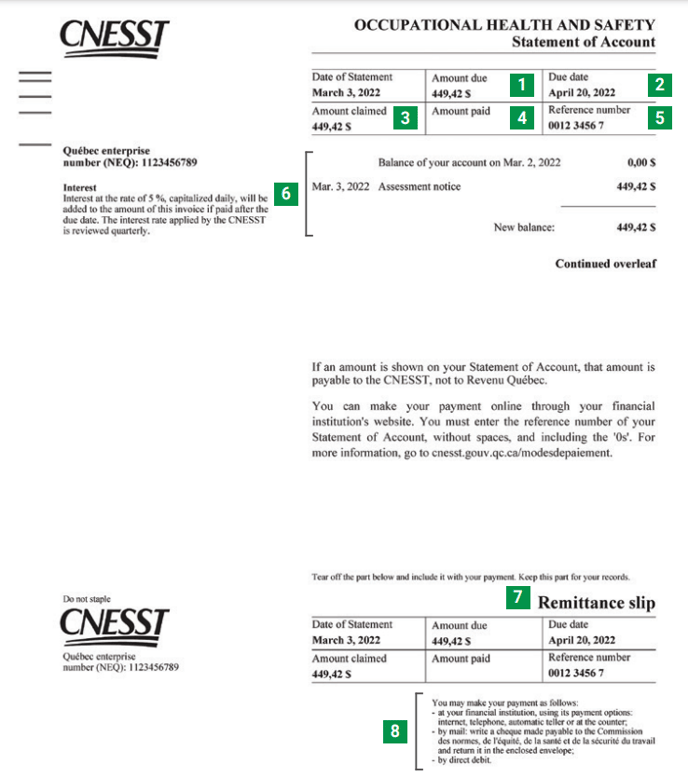
 Account balance as of the Statement of Account issue date
 Due date for receipt of payment by the CNESST
 Amount to be paid no later than the due date
 Box to enter the payment amount you are remitting to the CNESST
 Number that enables the payment to be applied to the employer’s file. It can also be used for online payment through a financial institution.
 Transactions field
 Remittance slip mailed by the CNESST. This slip must be included with the payment made at an automated teller, at the counter of a financial institution, or by mailed cheque.
 Accepted payment methods. For more information about payment methods, visit cnesst.gouv.qc.ca/modesdepaiement.
Understanding the Assessment Notice
The Assessment Notice lists information about the insurance premiums. It contains two sections.
The first section shows a breakdown of premiums by contribution year. Further information, if any, may include:
-
- expenses attributable to all files
- premium calculations for each classification unit
- periodic payments declared
- personal coverage
- retrospective premium adjustments
- trainees
The second section may include the following schedules:
Schedule—Personal coverage:
Lists information about individuals with a personal coverage plan.
Schedule—Auxiliary workers:
Lists the classification units and payroll amounts used to calculate insurance premiums for auxiliary workers.
Schedule—Periodic instalments:
Sets out the cumulative periodic payments declared and the calculation of the penalty for insufficient periodic payments, if applicable.
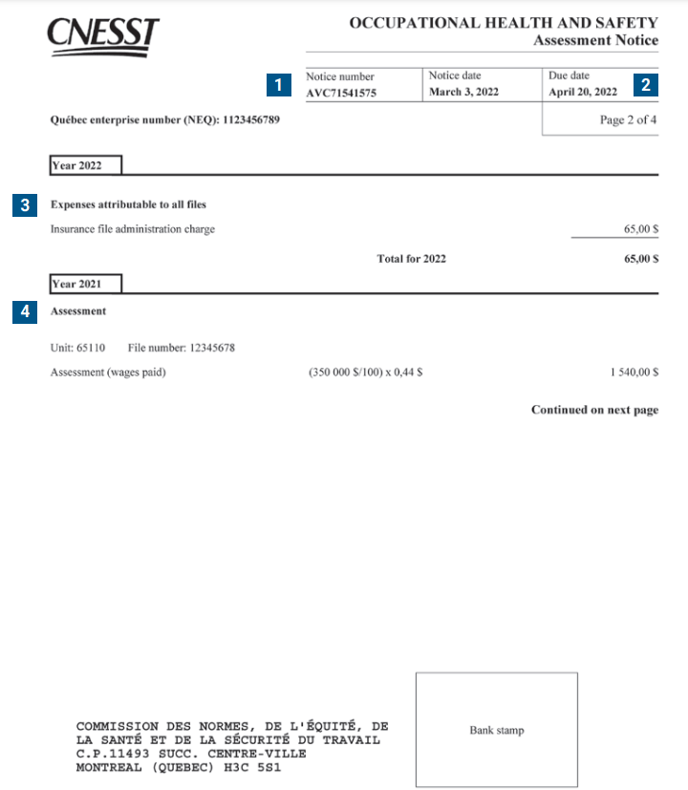
 Quote this notice number when requesting information about your Assessment Notice from the CNESST
 Same date as the one indicated in the Statement of Account—the due date for receipt of payment by the CNESST
 Expenses attributable to all files, including any penalty and interest charges, as well as insurance file administration charges (billed annually), which include the insurance file opening fee and other file management fees
 Detailed assessment calculation based on applicable payroll amounts and premium rates
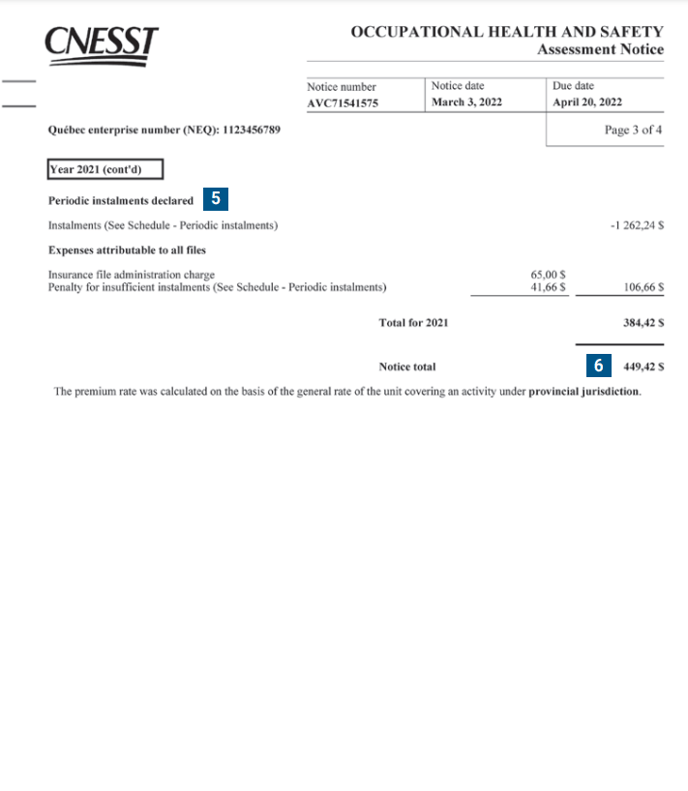
 Total periodic payments declared by the employer. The detailed payments appear in the Schedule—Periodic instalments
 Total amount shown in the Assessment Notice carried over to the Statement of Account
What is a Schedule-Periodic Instalments Notice and Its Purpose?
This schedule lists the total periodic payments reported during the year and may also include any penalty charges incurred as a result of insufficient periodic payments.
Understanding the Schedule-Periodic Instalments Notice
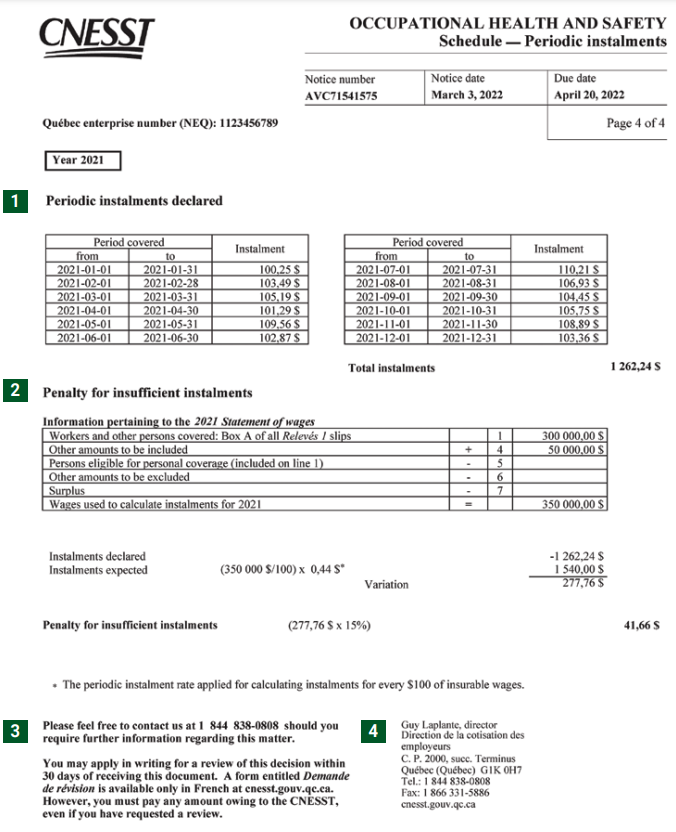
Total periodic payments declared by the employer
Penalty charges for insufficient periodic payments are added if the periodic payments reported for the year are smaller than the expected periodic payments. The expected periodic payment amounts are calculated using the information declared in the Statement of Wages (on lines 1, 4, 5, 6, and 7)
Information regarding your right to challenge the Assessment Notice
Information to contact us
What is an Insurance Premium Notice and Its Purpose?
The CNESST’s calculations for determining applicable insurance premiums are based on the following information: payroll amounts and premium rate (for every $100 of payroll).

The premium rate fluctuates according to the risk associated with a given industry sector. The premium rate may be either the specific classification unit rate or a personalized rate. The rate may also be raised to help compensate for a joint sector based association.
In order to calculate the insurance premium, the CNESST uses:
• the general unit rate for enterprises whose activities
come under provincial jurisdiction
• the special unit rate for enterprises whose activities
come under federal jurisdiction
The general and special rates for each classification unit are listed in the Schedule of Rates, which you may consult on CNESST's website.
For further information, please visit:
cnesst.gouv.qc.ca.
CNESST Guide resource:
https://www.cnesst.gouv.qc.ca/sites/default/files/documents/dc100-1021aweb_0.pdf